
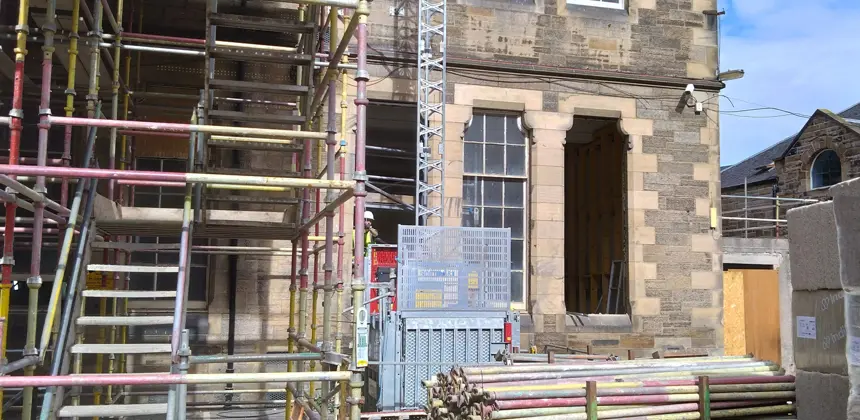
Development is continuing on the new Fringe Central, with the building works due for completion in spring 2026; shortly after that, the Fringe Society staff will move in ahead of the Edinburgh Festival Fringe 2026.
Sustainability has been a core part of the project’s planning and development – here’s a little more detail on what that means, especially when it comes to the building’s heating.
Sealing the building
To make the building as sustainable as possible, we first had to make it as efficient as possible. The first step was making it watertight: inspecting the building facades, repointing masonry and replacing roof slates where necessary. Our building contractor, Linear Design & Construct, has used products that are locally sourced (in line with the project’s overall sustainability) and breathable, ensuring the building is not damaged by the repairs.
Minimising heat loss
Historically, 6 Infirmary Street required a huge amount of energy to heat, only for most of it to be lost – predominantly via large, single-pane sash windows. We initially planned to restore the old windows, installing double-glazed panes of glass, but unfortunately they were in too poor a condition. Instead, we’re replacing them with new sash-and-case windows that remain in keeping with the original aesthetic and heritage advice.
Retaining heat
Our next challenge has been retaining heat inside the building, using multiple layers of insulation on the inside of the external walls:
- The first layer is a locally sourced wood fibre insulation that is blown into the existing wall cavity via small drillholes.
- Beneath the cavity, we’ve installed a new layer of breathable plaster on the stonework, improving insulation and preventing moisture buildup.
We’re also building a new wall lining over the internal walls, protecting the existing cornicing and concealing our utilities while allowing for multiple layers of natural insulation product. The insulation varies in thickness depending on the depth of the void: more expansive, denser insulation will be used where the void is thinner, so the same U-value (thermal performance) will be achieved.
These new walls will then be plastered and painted.
Changing the source of heat
The building’s old heating system was an industrial gas boiler suppling heat to old, pressed-steel radiators – the radiator design, together with the large hot water pipes, meant the building was highly inefficient. We’re installing new pipes and radiators, with heating supplied by air source heat pumps. The new system will need fewer, smaller radiators to heat spaces.
Releasing the heat
The building will be cooled naturally with functioning windows and vents. The vents will prevent condensation build-up and provide ventilation, while the windows will allow for the building to be cooled on hot days, with window alignment allowing for cross breeze (preventing the need for electric, energy-consuming fans). We’re also installing a smart heating system that will prevent heating and cooling from happening at the same time.
Future proofing
The new heating system will allow for our heat source to potentially be upgraded to improved systems in the future. The heat pumps could, for example, be replaced with a district heating system, with no modifications required.
The false walls and render will save the original structure and protect listed features. Other than a few new openings, such as doors, we’re retaining the building’s original fabric.
You can be part of the new Fringe Central
We’re delighted to have the support of DCMS and other partners in funding this project, particularly SP Energy Networks Transmission Net Zero Fund for funding sustainability improvements.
However, there is still a lot more we want to accomplish – find out how you can support the new Fringe Central:


